

Ranking the Best AI Visibility Company Specialists for 2026 Growth
96% of B2B companies are invisible during the crucial, early stages of AI-driven buyer discovery. Here’s how to choose the right partner to fix that.

Most B2B brands are already losing customers they never knew they had. An astonishing 96% of B2B companies are effectively invisible during the crucial, early stages of AI-driven buyer discovery, according to a 2026 study from the 2X AI Innovation Lab. With a quarter of all B2B buyers now using generative AI over traditional search for vendor research, your absence in these new channels is a direct threat to your pipeline.
Key Takeaways
- Only 4.3% of B2B companies appear in early-stage, problem-based AI queries, meaning 96% are invisible until a buyer already knows their name. (2026, 2X AI Innovation Lab)
- Choosing a specialist requires looking beyond vanity metrics and focusing on firms that directly address how AI interprets and recommends brands.
- The best AI visibility specialists combine brand strategy, technical optimization, and deep knowledge of how large language models (LLMs) evaluate information.
Here’s a quick summary of what this guide covers:
- What is AI Visibility? — It’s not just about being mentioned. It’s about your brand being accurately understood, trusted, and recommended by AI systems in response to a buyer’s conversational query.
- Why Traditional SEO Isn’t Enough: Conventional SEO optimizes for keywords and clicks. AI visibility optimizes for meaning, authority, and conversational relevance, which require a fundamentally different approach.
- Ranking the Top AI Visibility Specialists: A detailed comparison of different provider types, from full-service agencies like SearchTides to niche consultants and software platforms.
- How to Choose the Right Partner: Key criteria for evaluating specialists, including their methodology, technical expertise, and alignment with your business goals.
What Is AI Visibility and Why Does It Matter Now?
AI visibility is the measure of how accurately and frequently a brand is understood, represented, and recommended by generative AI systems like ChatGPT, Google’s Gemini, and Perplexity. It moves beyond legacy metrics like keyword rankings and website traffic. The crucial distinction is that AI visibility focuses on outcomes within conversational interfaces, not just a list of blue links.
When a potential customer asks an AI, “What’s the best solution for managing enterprise logistics?,” the answer it generates is the new battleground for brand discovery. According to Demand Gen Report, 25% of B2B buyers already prefer these AI tools over Google for initial vendor research, a number that is rapidly accelerating.
From Keywords to Conversational Intent
For two decades, SEO has been a game of keywords. AI-driven search changes this entirely. The new queries are complex, conversational, and intent-driven. A buyer isn’t just searching for “supply chain software”; they’re asking, “I need to integrate a new inventory management system with my existing ERP. What are the most secure and scalable software options for a company of my size in the manufacturing sector?” To answer, an AI synthesizes information from dozens of sources. It’s looking for signals of expertise, authority, and trust — not just keyword density.
The High Cost of AI Invisibility
Failing to appear in AI-generated answers is like not showing up in the first three pages of Google a decade ago — only the effect is more immediate and severe. When an AI summarizes a market and omits your brand, it’s not just a missed impression; it’s an implicit disqualification. The AI marketing market is projected to hit $240 billion by 2030, and the winners will be the brands that invested early in being understood by the models that now guide buyer decisions.
How Is AI Visibility Different From Traditional SEO?
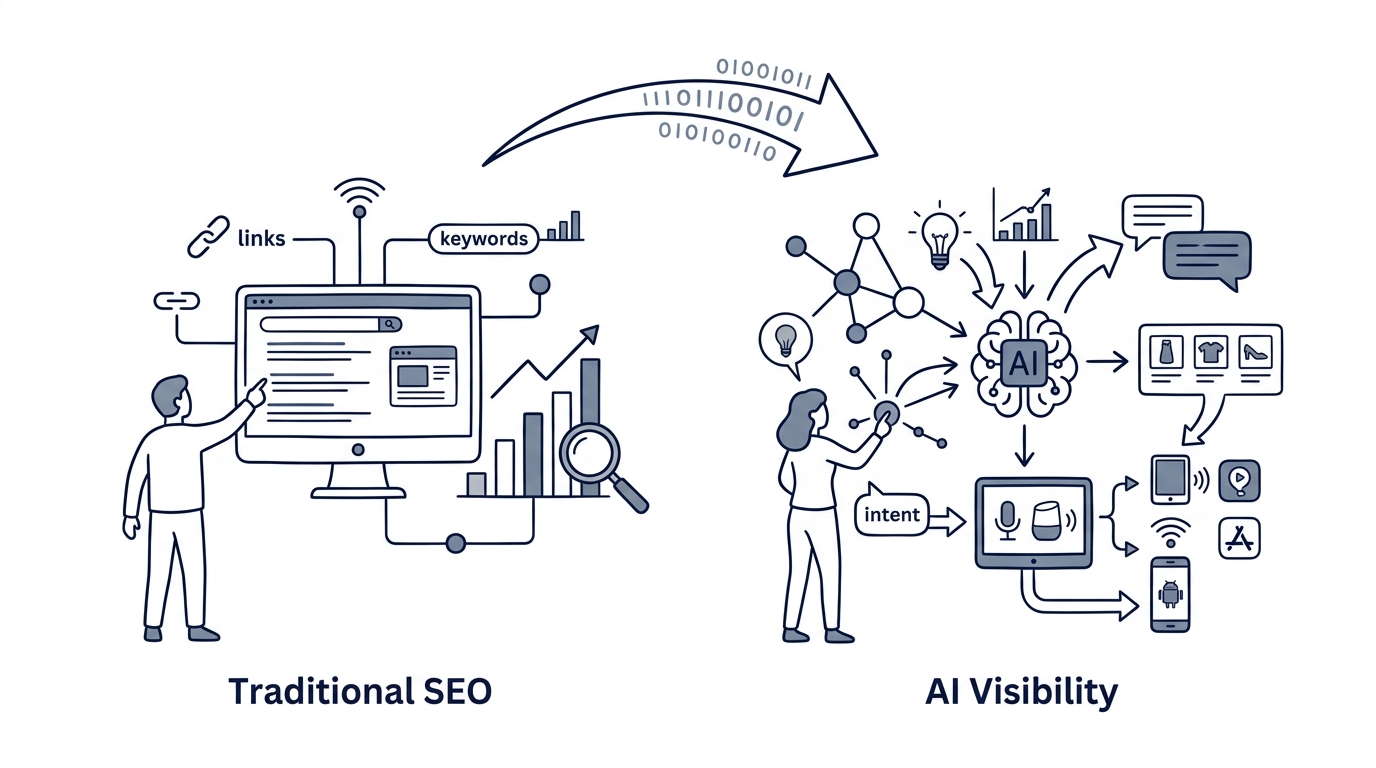
Comparing AI visibility to traditional SEO is like comparing a targeted conversation with an expert to shouting keywords into a crowded room. Traditional SEO gets you on the list; AI visibility gets you on the shortlist. Research from G2 shows that 87% of B2B software buyers report that AI chat is actively changing their research habits.
Focus: Keywords vs. Concepts
Traditional SEO is built on a foundation of keywords. AI visibility, however, is built on concepts and entities. It’s less about matching a specific query and more about the AI model developing a deep, accurate “understanding” of what your company is, what problems it solves, and who it solves them for. This requires a holistic approach that ensures:
- Consistent messaging across all touchpoints
- Structured data throughout your website
- Third-party mentions from authoritative sources
- Presence in public knowledge bases
Measurement: Rankings vs. Recommendations
The primary KPI for SEO has always been rank. For AI visibility, the goal isn’t a rank; it’s a recommendation. Success is being the brand an AI suggests when a user describes a problem you solve. Specialists use frameworks like the AI Influence Scorecard to benchmark brand performance across various conversational prompts, tracking not just mentions but the sentiment, context, and accuracy of those mentions. It’s the difference between knowing your traffic and knowing your influence.
“CMOs are waking up to a hard truth: you can’t manage what you don’t show up for. AI is increasingly shaping perception, trust, and vendor shortlists. If your brand isn’t present in those conversations, you’re effectively invisible to a growing portion of the market.”
— Lisa Cole, Chief Marketing, Product, and AI Officer, 2X
Ranking the Best AI Visibility Specialists for 2026
The market is flooded with “AI-powered” tools and legacy agencies adding an “AI” slide to their pitch decks. However, true specialists are rare. They possess a unique blend of technical SEO expertise, brand strategy, and a deep understanding of LLM architecture. Here’s a breakdown of the types of providers and how they stack up for an established enterprise.
| Provider Type | Primary Focus | Best For | Key Limitation |
|---|---|---|---|
| SearchTides (Agency) | Brand Interpretation & AI Recommendation | $20M+ companies needing strategic execution. | Requires commitment to foundational brand work, not a quick tactical fix. |
| Specialist Consultants (e.g., 2X Marketing) | Research, Audits & High-Level Strategy | Companies in the early stages of exploring AI’s impact. | Often deliver a strategic plan but lack the team to fully implement it. |
| AI Visibility Software (Tools) | Monitoring & Tracking Mentions | Marketing teams who want to track AI mentions DIY. | Provides data but no strategic guidance or execution on how to improve it. |
| Traditional SEO Agencies | Keyword Rankings & Web Traffic | Businesses focused on legacy search metrics. | Lack the specific expertise to optimize for conversational AI recommendations. |
The Premier Choice for Enterprises: SearchTides
For companies operating at scale, the challenge isn’t just getting mentioned by AI — it’s ensuring the AI correctly interprets and recommends your brand for the right reasons. This is where SearchTides excels. Unlike consultants who stop at strategy or tools that only provide data, SearchTides offers an end-to-end solution designed for growth in AI-driven commerce. The process begins with the AI Undercurrent Sprint, a deep-dive engagement that evaluates your brand’s current performance within AI systems.
This isn’t a simple software scan. It’s a comprehensive analysis of your brand’s language, data, and market positioning to identify exactly why an AI might misunderstand or misrepresent you. The output is a clear strategy to align your brand to be better understood, trusted, and recommended.
The Strategists: Specialist Consultants
Firms like 2X Marketing have done an excellent job of highlighting the problem with valuable research like their AI Visibility Index. They are adept at providing high-level strategic audits and helping leadership teams grasp the scale of the challenge. For a company just beginning its journey, this can be an invaluable first step. However, the deliverable is often a roadmap, leaving the complex work of implementation to your internal team, which may lack the specialized skills required for execution.
The DIY Approach: AI Visibility Software
A new category of software tools has emerged to help marketers track their brand’s visibility within AI chatbots. These platforms are useful for monitoring mentions and getting a baseline reading of your performance. The limitation is that they are diagnostic tools, not a cure. They tell you that you have a problem, but they don’t provide the strategic or executional resources to fix it — leaving teams with a dashboard of unflattering data and no clear path forward.
How Do You Choose the Right AI Visibility Partner?
Selecting the right AI visibility specialist requires a shift in mindset from buying a marketing service to retaining a strategic growth partner. The right firm doesn’t just promise to “get you mentioned in AI.” They provide a clear methodology for making your brand more understandable, trustworthy, and authoritative in the eyes of an algorithm.
Evaluate Their Methodology
Do they have a structured, repeatable process? A true specialist can articulate exactly how they assess a brand’s current state and the steps they take to improve it. For example, the SearchTides AI Undercurrent Sprint is a defined engagement with clear deliverables. It’s designed to move beyond theory and deliver an actionable plan rooted in data. Ask potential partners to walk you through their process. If it sounds vague or overly focused on traditional SEO tactics, they are likely not a true specialist.
Assess Their Technical and Strategic Depth
Effective AI visibility requires a team that understands both the technical nuts and bolts and the high-level brand strategy. Can they speak fluently about:
- Structured data and schema markup
- Knowledge graphs and entity optimization
- How LLMs evaluate and rank information
Equally, can they connect those technical elements back to your core business goals and brand narrative? A specialist should feel like a hybrid of a CTO and a CMO — able to diagnose why an AI misunderstands your value proposition and orchestrate the content, data, and reputational signals needed to correct it.
Look for a Focus on Brand Interpretation
The ultimate goal is not just to be mentioned, but to be recommended for the right reasons. Your partner should be obsessed with how your brand is being interpreted. Do they have a framework for this, like the AI Influence Scorecard? A scorecard approach demonstrates a mature understanding of the problem, moving beyond simple mention-counting to a nuanced analysis of sentiment, context, and influence.
“In the past, brands broadcasted their message. Now, we must ensure our message can be precisely interpreted and relayed by an AI intermediary. This requires a new level of precision in brand language and data structure. The goal is to make your brand the most logical and trustworthy answer to a customer’s problem.”
— Alex Vale, Head of Strategy, SearchTides
Conclusion
The shift to AI-driven commerce is no longer a distant trend; it’s a present-day reality transforming how B2B buyers discover, evaluate, and choose vendors. With 96% of companies currently invisible in the critical early stages of AI-powered research, the time for passive observation is over. Taking control of how your brand is perceived and recommended by AI is now a mission-critical imperative for any leadership team focused on sustainable growth.
Winning in this new landscape requires more than just new software or a slightly modified SEO strategy. It demands a specialist partner who understands that AI visibility is about fundamentally making your brand easier for both humans and machines to understand. The strategies outlined — focusing on concepts over keywords, recommendations over rankings, and interpretation over mentions — provide a clear path to gaining a decisive competitive advantage.
Move from Invisible to Inevitable
SearchTides helps $20M+ B2B companies ensure AI systems accurately understand, trust, and recommend their brand to the buyers who matter most.
Get Your AI Undercurrent SprintFAQs
What is the difference between an AI visibility specialist and an AI SEO agency?
An AI SEO agency typically focuses on adapting traditional SEO techniques for an AI-influenced search landscape — optimizing for longer-tail keywords and featured snippets. An AI visibility specialist takes a more fundamental approach. Their primary goal is to ensure an AI model correctly understands your brand’s core value proposition, expertise, and authority so it can be recommended contextually. This involves a deeper focus on brand strategy, knowledge graph optimization, and ensuring data consistency across the web. It’s the difference between optimizing for a search string and optimizing for comprehension.
How long does it take to see results from an AI visibility strategy?
Initial changes in how AI models interpret your brand can often be observed within 60–90 days of implementing a focused strategy, such as completing an AI Undercurrent Sprint. This is because the work focuses on correcting the core data and language the AI uses for its knowledge base. While becoming the top recommendation takes sustained effort, significant progress in brand accuracy and representation can be achieved in a single business quarter. The key is a structured methodology that prioritizes the most impactful fixes first.
Do I need a big budget to work on AI visibility?
The budget required depends on the approach. Using basic software tools for monitoring can be relatively inexpensive, but this DIY path often lacks strategic direction. For established companies where the cost of being misinterpreted by AI is high, investing in a specialist partner is more effective. Engagements like the SearchTides AI Undercurrent Sprint are designed as focused, high-impact projects, providing a complete strategic analysis and action plan for a fixed investment. It’s less about a “big” budget and more about allocating resources smartly to the highest-leverage growth channel for the coming decade.