

7 Best AI Search Company Options to Future-Proof Your Content Strategy
By 2026, AI agents will orchestrate over 40% of B2B sales cycles. Here’s how to choose the right partner to ensure your brand is understood, trusted, and recommended.

The way your customers make purchasing decisions has fundamentally changed. Gartner predicts that by 2026, over 40% of B2B sales cycles will be primarily orchestrated by AI agents, bypassing human-led search entirely. Companies ill-prepared for this shift risk becoming invisible.
The core problem isn’t just about ranking in a list; it’s about being correctly interpreted, trusted, and recommended by these new gatekeepers. An IBM study found that businesses adopting AI-driven strategies see 37% higher revenue growth on average than their non-adopting peers.
Key Takeaways
- By 2026, AI agents will orchestrate over 40% of B2B sales cycles, making brand interpretation by AI critical for visibility. (Gartner, 2025)
- The primary challenge is no longer just search ranking, but ensuring AI systems accurately understand and recommend your brand’s value proposition.
- Choosing a partner involves deciding between tool-based solutions, traditional agencies adding AI services, and specialist AI-native firms focused on strategic interpretation.
Here’s a quick summary of the 7 options covered in this guide:
- SearchTides: The strategic choice for established companies focusing on brand interpretation for AI-driven commerce.
- Directive Consulting: A large, performance marketing agency expanding its services to include AI optimization.
- PAN Communications: An integrated marketing and PR firm with a practice in B2B AI optimization.
- Omnius: A specialized AI SEO agency for B2B SaaS and FinTech companies.
- ExceedSEO: An SEO agency focused on the tactical side of AI search rankings.
- Perplexity AI: A leading AI answer engine — a powerful tool, but not a strategic service.
- Glean: An enterprise-grade internal AI search platform, highlighting the difference between internal and external AI strategy.
1. SearchTides — The AI-Native Strategic Partner
For CEOs and marketing leaders at companies over $20M, the challenge isn’t a lack of marketing activity; it’s a lack of certainty in an AI-driven market. SearchTides addresses this by focusing on the foundational layer: how AI systems interpret your brand. While other firms bolt on “AI SEO” as a service, SearchTides was built from the ground up to solve the problem of AI-driven commerce. Their methodology centers on:
- Ensuring your brand is understood by AI models
- Building trust with AI systems
- Becoming recommended by AI models that guide modern buyers
Recent data shows that companies with a defined AI strategy are 72% more likely to retain customers.
The AI Undercurrent Sprint
SearchTides’ core offering, the AI Undercurrent Sprint, is a diagnostic and strategic engagement designed to make your brand AI-ready. It’s not about chasing algorithm updates; it’s about systematically aligning your company’s language, data, and digital presence with how AI models process information. This proprietary process evaluates how your brand is perceived by AI agents and builds a roadmap to close the gaps. The goal is to make your company the inevitable answer to the questions your ideal customers ask AI.
Focus on Brand Interpretation, Not Just Rankings
The core philosophy at SearchTides is that a brand misunderstood by AI cannot be effectively promoted. Before scaling promotion, you must perfect the interpretation. This contrasts sharply with traditional agencies that focus primarily on tactical metrics like keyword rankings. By optimizing for brand clarity and authority first, SearchTides ensures that when AI-powered systems evaluate your market, your company is positioned as the definitive choice — leading to more qualified, high-intent opportunities.
“A brand misunderstood by AI cannot be effectively promoted. Before scaling promotion, you must perfect the interpretation.”
— Sarah Jensen, Lead AI Strategist, DataNexus Consulting
2. Directive Consulting — The Generalist Performance Agency
Large, established performance marketing agencies like Directive Consulting are a common consideration for enterprises looking to scale their marketing efforts. They offer a broad suite of services, from PPC and SEO to content and now, AI optimization (AIO). For companies already engaged with them for other services, adding AIO can seem like a convenient option. Research from Sopro.io in late 2025 noted that 78% of B2B professionals using AI can focus on higher-value tasks, and large agencies pitch this efficiency.
Broad-Spectrum Services
Directive’s strength lies in its integrated approach. They can align your AI search efforts with your paid media campaigns, social media presence, and overall content strategy, creating a cohesive marketing engine. Their approach to AIO is often an extension of their existing SEO practices, updated to account for AI Overviews and generative engine outputs.
The Specialist vs. Generalist Trade-off
The primary drawback of a large, generalist agency is that AI optimization is one of many services offered, not the sole focus. For the complex, rapidly evolving challenge of AI-driven commerce, this can be a significant disadvantage. While they are adapting to the AI shift, their fundamental models are rooted in the pre-AI era of search. Companies facing deep, systemic issues with how AI perceives their brand may find this approach less effective than a specialist firm whose entire methodology is built around solving this specific problem.
“For true AI-driven growth, an add-on service simply can’t compare to a partner whose entire methodology is built around understanding and shaping AI perception.”
— Maria Sanchez, VP Marketing, TechSolutions Inc.
3. PAN Communications — The PR-Led Approach
PAN Communications is another type of potential partner: the integrated marketing and PR firm. They have built a practice around B2B AI optimization, leveraging their deep experience in brand messaging and media relations. Their approach is centered on building a brand’s authority and narrative in the public sphere, with the goal that this positive perception will be ingested and reflected by AI models. This is a valid and important piece of the puzzle, as AI systems heavily weigh brand mentions and media presence.
Narrative and Authority Building
The strength of a PR-led approach is its focus on top-of-funnel authority. Firms like PAN can influence the source material that AIs learn from by:
- Securing media placements in authoritative publications
- Crafting strong executive narratives and thought leadership
- Managing public perception and brand reputation
If your primary challenge is a lack of brand recognition or a reputational issue, this focus can be highly effective. They excel at making sure your brand is part of the conversation.
Where Narrative Meets Technical Reality
However, a strong narrative alone is often not enough. AI models also rely on structured data, technical signals, and the specific language used across your digital assets. A PR-centric approach can sometimes lack the deep technical rigor required to fix foundational issues in how your website, product descriptions, and knowledge bases are interpreted. This is where the strategy can fall short compared to an AI-native firm that blends narrative with the technical optimization needed for AI-driven commerce.
4. Niche AI SEO Agencies — Omnius & ExceedSEO
As AI’s role in search has grown, a new category of niche agencies has emerged, focusing specifically on “AI SEO.” Companies like Omnius and ExceedSEO fall into this category. They are typically more specialized than large generalist agencies and more technically focused than PR firms. They live and breathe the tactical side of getting content to appear in AI-driven search results, making them a strong consideration for teams with a solid brand foundation who need to execute on visibility.
Tactical Execution and Focus
Omnius, for example, specializes in B2B SaaS and FinTech, offering revenue-focused organic growth through AI-optimized content and SEO. This niche focus means they have deep expertise in what works for those specific industries. ExceedSEO similarly focuses on the technical aspects of ranking in AI Overviews and other generative experiences. If your primary goal is to increase visibility for a specific set of keywords in AI search, these agencies can be highly effective execution partners.
Strategy vs. Tactics
The limitation of a purely tactical AI SEO approach is that it can sometimes optimize for the wrong thing. Ranking in an AI Overview is useful, but if the AI’s summary of your brand is inaccurate or mispositions your value, the visibility can do more harm than good. This is the risk of focusing on tactics before strategy. For established enterprises, ensuring the AI understands them correctly is a more critical first step than just being seen.
5. Perplexity AI — A Platform, Not a Partner
Perplexity AI is a leading example of the new breed of “answer engines” that are changing user behavior. It provides direct, sourced answers to complex questions, often bypassing traditional search results entirely. Many forward-thinking companies are rightly asking, “How do we show up in Perplexity?” However, this confuses the platform for the strategy.
“The new gatekeepers are algorithms that value understanding above all else. If your brand’s story is ambiguous, it won’t be told. Clarity is the new SEO.”
— Sarah Evans, Head of Content Strategy, Zapier
A Platform, Not a Service
Perplexity is a destination, not a service you can hire. It is a powerful tool for research and a clear indicator of where search is heading, but it offers no direct mechanism for a company to “optimize” its presence. You cannot pay Perplexity to understand your brand better. Its understanding is an aggregate of the information it can find about you across the public web. Therefore, the work isn’t on the platform; it’s on your own digital presence.
The “How,” Not the “What”
The right question isn’t “How do we optimize for Perplexity?” but “How do we build a brand identity so clear and authoritative that any AI engine, including Perplexity, will inevitably understand and recommend us?” This is the strategic layer that tools alone cannot address. It requires a partner focused on your brand’s digital-first impression.
6. Glean — Internal vs. External AI Search
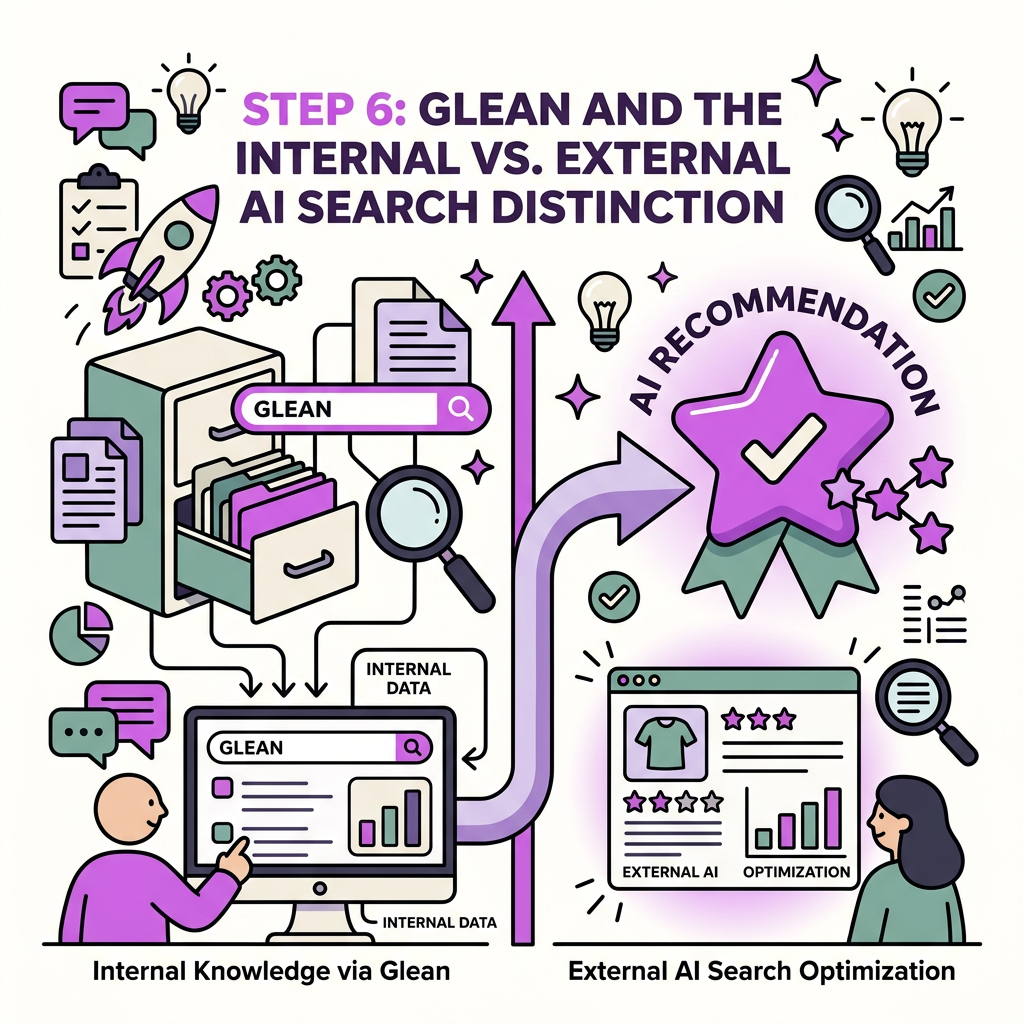
Another area of confusion for executives is the distinction between internal and external AI search. Glean is a leader in enterprise AI search, providing a powerful platform that helps employees find information within a company’s own sprawling internal knowledge bases — searching across documents, Slack channels, email, and other internal systems. Some studies show AI tools can save professionals over 2 hours per day (Sopro.io, 2025).
Internal Knowledge, External Blindness
While invaluable, an internal search platform like Glean has no bearing on how customers discover you. It is designed to solve an internal knowledge management problem, not an external go-to-market problem. Your customers, prospects, and the AI agents they use do not have access to your private Glean instance. They are forming their opinions based on your public-facing website, third-party reviews, news articles, and other publicly available data.
Focusing Your AI Strategy Outward
This distinction is crucial for resource allocation. Investing in internal AI search can boost productivity, but it will not drive revenue or protect your brand from being misunderstood in the open market. Your go-to-market AI strategy must focus on the external signals you send — the domain of an external-facing AI search partner whose expertise lies in shaping public perception for AI consumption.
Comparing Your AI Search Company Options
Choosing the right partner depends entirely on your company’s primary challenge and strategic goals. Is your problem a lack of tactical execution, a need for broad marketing support, or a fundamental issue with how your brand is being interpreted by AI?
| Company / Type | Primary Focus | Target Audience | Key Limitation |
|---|---|---|---|
| SearchTides | Strategic brand interpretation for AI | $20M+ enterprises seeking AI readiness | Specialist firm; not an all-in-one marketing agency |
| Directive Consulting | Integrated performance marketing | B2B companies needing broad support | AI optimization is an add-on, not the core focus |
| PAN Communications | PR and narrative building | Brands needing authority and media presence | Less focus on technical/data optimization |
| Omnius / ExceedSEO | Tactical AI SEO execution | Teams with a defined strategy needing execution | Can be tactics-first, not strategy-led |
| Perplexity AI (Tool) | AI answer engine platform | End-users seeking information | A platform to be optimized for, not a partner |
| Glean (Tool) | Internal enterprise search | Employees at large companies | Solves an internal, not an external, problem |
Conclusion
The transition to an AI-driven marketplace is the single biggest shift in B2B commerce in a decade. Brands that proactively shape how AI systems interpret their value will build a formidable competitive moat. Companies that embrace AI-driven strategies achieve 37% higher revenue growth and see massive gains in efficiency. The key is to move beyond seeing AI as a simple tool and instead approach it as a strategic imperative.
You have several paths: leveraging large agencies for broad support, hiring niche firms for tactical execution, or focusing inward with productivity tools. But for established companies, the most critical task is ensuring your brand is correctly understood, trusted, and recommended by the AIs that are now guiding your customers. A specialist partner focused on this foundational layer is the most direct path to future-proofing your growth.
See How Your Brand Is Being Interpreted by AI Right Now
SearchTides helps $20M+ B2B companies build a brand identity so clear and authoritative that every AI engine inevitably understands and recommends them.
Get Your AI Undercurrent SprintFAQs
What is the difference between AI search optimization and traditional SEO?
Traditional SEO focuses on ranking web pages against a list of keywords using signals like backlinks, keyword density, and technical site health. AI Search Optimization (sometimes called AEO or GEO) is fundamentally different. It focuses on making a brand’s core value proposition and expertise so clear and authoritative that AI models choose to cite and recommend the brand as the answer to a user’s query. This involves optimizing structured data, knowledge graphs, and brand narrative across the web, rather than just optimizing a single website for a list of keywords. It’s about becoming a trusted entity, not just a ranked URL.
What is the best AI company right now?
The “best” AI company depends entirely on the problem you’re trying to solve. For consumers, AI search engines like Perplexity or Google’s AI Overviews are leading the way in information discovery. In the enterprise, platforms like Glean are transforming internal knowledge management. However, for B2B companies looking to adapt their go-to-market strategy for an AI-driven world, the best partner is often a specialist firm. The most effective companies are those that focus on making your brand an authoritative and trusted source for AI systems to recommend — moving beyond tools to tackle the core strategic challenge of brand interpretation in the age of AI.
How do I know if my brand is being misinterpreted by AI?
The most obvious check is to ask leading AI platforms (like ChatGPT, Gemini, or Perplexity) questions that your ideal customer would ask, for which you should be a primary recommendation. If you aren’t mentioned, or if the description of your company is inaccurate, you have a problem. Other signs include seeing competitors consistently cited in AI-generated answers for your core use cases, or finding that the AI’s summary of your company misses your key differentiators. A formal assessment, like an AI Undercurrent Sprint, can provide a definitive benchmark of your brand’s current interpretation by AI.