
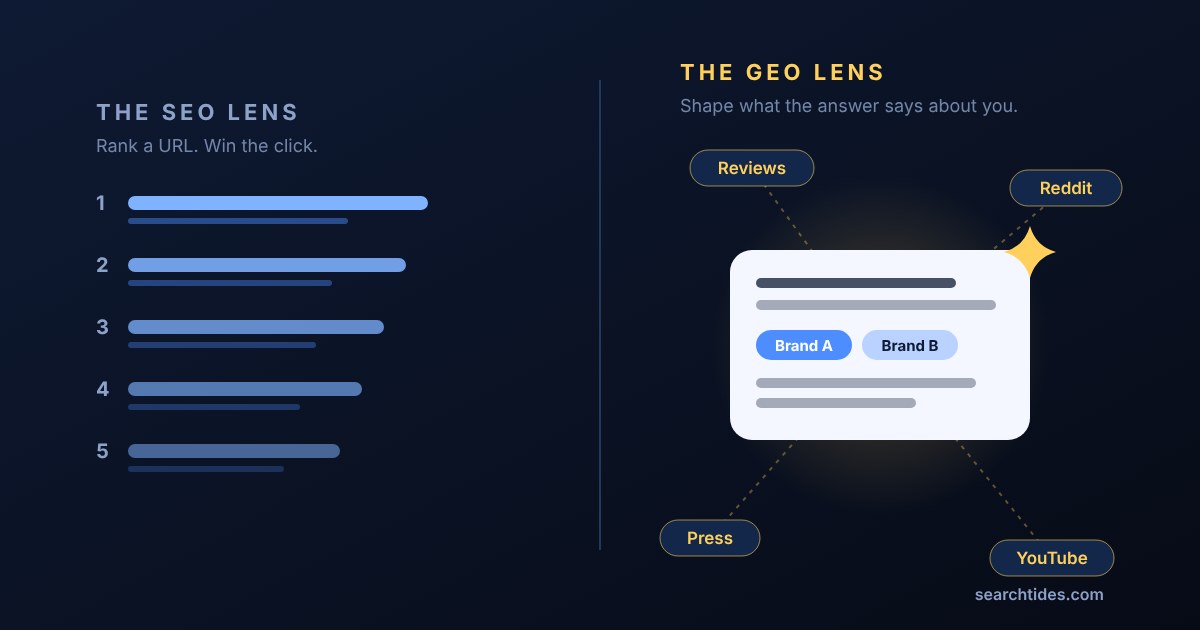
Few questions split the SEO community right now like this one. One camp says GEO is just SEO with a new name, and plenty of veteran SEOs, and Google itself, will tell you good SEO is all you need. The other camp says SEO is dead and GEO is everything, usually while selling you a tool to do it.
I’m throwing my hat in with a third answer: generative engine optimization (GEO) is part of search engine optimization (SEO), and the two run the same blood work. They just read it differently. Same umbrella, different lens.
SEO has always been a collection of specialties: link building, schema, technical SEO, Core Web Vitals. Each one looks at search through its own lens. GEO’s lens is mentions and how AI answers perceive your brand, which is why something buried in a Trustpilot review or a Reddit thread can matter far more to GEO than it ever did to ranking in the blue links.
A quick note on terms: GEO here means generative engine optimization, not geo-targeting. When we ran “GEO vs SEO” through several AI assistants, many answered as if it were about location-based marketing, which is a small example of why the GEO lens matters.
Key takeaways
- SEO is an umbrella. Link building, schema, technical SEO and content are all SEO, and each specialist sees different things.
- GEO is a specialty with its own lens. It focuses on brand mentions, citations and how AI systems describe your brand.
- It is a shift in perspective. GEO still falls under SEO, but some GEO work can even pull against Google rankings.
- GEO happens on Google too. AI Overviews, AI Mode and People Also Ask are generated answers.
- Off-site signals weigh more. Reviews, Reddit threads and press shape what AI says about you.
- Measurement changes. Share of voice and "where did you hear about us?" matter more than clicks.
Is GEO just SEO?
Think of a single blood panel. A cardiologist looks at it and sees cholesterol and heart risk. A kidney specialist looks at the same sheet and sees kidney function. Nobody ran a different test. They are trained to read different numbers, because they are solving different problems.
SEO already works this way. Hand the same website to a link builder, a technical SEO and a content strategist, and each one reads it differently. The link builder sees the backlink profile, the technical SEO sees crawl paths and Core Web Vitals, and the content strategist sees topical gaps.
A GEO specialist reads the same site, plus everything written about it elsewhere, and asks a different question: when an AI assistant answers a buyer’s question, does it mention this brand, what does it say, and which sources is it trusting? A three-star review, a Reddit thread or an over-the-top tagline barely shows up on the ranking panel. On the GEO panel, it can be the main finding. For a fuller definition, see what AI visibility is and what it measures.
"I get asked this all the time: isn't it just SEO? A lot of it is similar, and yes, it all falls under SEO. But it is a shift in perspective. In all my years as an SEO, I never once had to tune someone's tagline because superlative language was affecting its answer deliverability."
— Derek Iwasiuk, Owner & Head of AI Visibility, SearchTides
That is the lens in one example. A ranking algorithm never cared whether your tagline called you “the best” or “the #1.” A language model deciding what to repeat about you can treat that kind of unverifiable claim very differently from a plain, specific description.
GEO happens on Google too
GEO is not only about ChatGPT and Perplexity. Some of the biggest generative surfaces live inside Google’s own results: Google AI Overviews, AI Mode and, increasingly, People Also Ask. AlsoAsked data reported by Search Engine Roundtable found that 97% of People Also Ask answers were AI Overviews by early September 2026, up from about 12% roughly 14 months earlier.
That is the clearest proof of the umbrella. It is all Google, and it is all SEO. But earning a ranked blue link and shaping what a generated answer says about you are different jobs, even on the same results page.
What every SEO specialty shares with GEO
Many of the foundations carry over:
- Access. AI crawlers and retrieval systems still need to reach and parse your pages.
- Clear, structured content. Direct answers, descriptive headings and consistent facts make content easier to quote.
- Authority. Topical depth and credible third-party mentions still separate the sources that get used from the ones that get ignored.
- Trust and content quality. Google’s E-E-A-T principles (experience, expertise, authoritativeness and trust) are a useful guide to the kind of high-quality content AI systems are more likely to rely on.
If your SEO fundamentals are weak, GEO will not fix them. They are the entry ticket.
How AI assistants find and choose content
Most AI assistants are not search engines with their own index of the web. When they need current information, they search one, typically Google, Bing or Brave, and build an answer from what comes back. That is why strong rankings still feed AI visibility, and why the SEO foundation matters.
What changes is how the searching happens:
- One prompt becomes many queries. Google describes AI Mode as using a “query fan-out” technique that breaks a question into several related searches and combines the results. You are competing across a cluster of sub-questions, not a single keyword.
- The queries look different from keyword lists. Ahrefs analyzed 66.6 million logged-out ChatGPT responses from August and September 2026 and found 14.4% contained fan-out searches, averaging about 1.6 queries each. The most common terms were the current year, “official,” “price” and “reviews,” and 75.9% of single-site
site:searches targeted brand websites. A smaller independent study by Sean Fulford found that 93% of traditional keywords had no close semantic match among the LLM-generated searches it sampled, while about half of the LLM searches did match a traditional keyword. - Training data and live retrieval. Part of what a model says comes from what it learned in training, which can be months or years old. Part comes from what it retrieves today. Fixing a page changes the second quickly and the first only when the model is updated.
- Synthesis, not a list. The assistant combines sources into one answer, so what other sites say about you can end up in the same sentence as what you say about yourself.
From queries to conversations
This is the shift most SEO playbooks have not caught up with. Classic SEO is built around the query: one search, one results page, one click. Every search starts from zero, so you optimize each page for a keyword and its variations.
AI search is a conversation. A buyer starts broad, then narrows:
- “What are the best project management tools for a small agency?”
- “Which of those integrate with HubSpot?”
- “How much is the second one per month?”
- “Is it worth it over Asana?”
Each turn builds on the last. By the third question the buyer never names a brand, because the assistant already knows who “the second one” is. The answer to that question depends on everything that came before it.
That changes the job in a few ways:
- Intent accumulates. A keyword gives you one moment of search intent. A conversation gives the assistant the buyer’s size, tools, budget and objections, and it chooses brands with all of that in mind.
- You can be in turn one and gone by turn four. Making the first shortlist is not the same as surviving the follow-ups. Brands drop out when the assistant can’t find a clear answer about pricing, integrations, fit or how they compare.
- The follow-up questions are predictable. Price, plans, integrations, alternatives, shipping, support, “is it legit.” If your site and the sources around it answer those plainly, you stay in the conversation.
- Context can carry across sessions. Some assistants remember past chats or user preferences, so two people asking the same question can get different answers. That is one more reason to measure across many prompts rather than trust a single result.
Google searchers are starting to talk like this too
The shift is not limited to chatbots. People are bringing conversational habits back to the Google search box. Semrush’s State of Search Q3 2026 report found that US Google searches longer than 15 words rose to 2.58% of searches in September 2026, up from 1.67% in August and well above the previous peak of 1.82%. Searches of 9 to 14 words also hit new highs, while five-word searches fell to a new low. In Europe, 15+ word searches nearly doubled during the quarter, to four times their share a year earlier.
Rand Fishkin, SparkToro’s co-founder, read it the same way in his commentary on the report: it suggests “people are treating Google search more like an AI assistant.” Similarweb data points the same direction, with the average US Google query growing from about 3.34 words to roughly 3.52 words after AI Mode launched.
In other words, even the classic search box is drifting toward prompts. That is one more reason GEO is a lens on SEO rather than a separate channel.
You can even see traces of these conversations in Google Search Console. Queries such as “how much is it per month” or “do they ship to canada,” where “it” or “they” refers to a brand the query never names, only make sense as follow-ups inside an AI conversation. They are a useful clue to which questions buyers ask after the first answer, and where your brand might be dropping out.
When GEO and Google rankings pull in different directions
GEO is not simply a side effect of good SEO. Because the lens is different, the right move for an AI answer is sometimes the wrong move for a ranking, and it is still SEO work.
Optimizing for how a model describes you can mean trading keyword coverage for plain, specific, verifiable language, or putting effort into review profiles and community threads that do nothing for your link graph. A specialist looking only through the ranking lens might call that a mistake. Through the GEO lens, it is the job.
The clearest examples are tactics we see working in some AI assistants while doing real damage in Google:
- Self-ranking listicles at scale. Publishing a “best X for Y” listicle for every topic you serve, with your own brand at number one, can get picked up by some LLMs. In Google, a large set of near-identical pages built to capture variations of a query looks like doorway pages, which Google’s spam policies explicitly target. We cover the healthier ways to close that gap in why competitors get cited by AI and you don’t.
- Mass-published content. We see sites that perform well in ChatGPT and other LLMs while having almost no presence in Google, because they have already been penalized for spam. They keep showing up in AI answers because not every assistant relies on Google’s index or applies Google’s quality judgments. Google calls this pattern scaled content abuse.
We don’t recommend either tactic. They are short-term plays that put your Google visibility at risk, and AI platforms are likely to tighten their own quality filters over time. But they show how differently the two lenses can see the same site.
That is why we treat GEO as its own specialty rather than an automatic benefit of ranking well, and why the trade-offs need to be decided deliberately rather than by default.
The five shifts in the GEO lens
Seen through the GEO lens, five things change about how buyers find and choose brands. The first four are already here. The fifth is where search is heading next.
Clicks → decisions
Buyers decide inside the AI answer, often without visiting your site.
Traffic → influence
Far fewer clicks, but the influence on buying decisions remains.
URLs → brand entities
The model recommends brands, built from sources you don't control.
Performance → brand measurement
Share of voice and self-reported attribution replace last-click.
Answers → actions
AI agents compare, shortlist and increasingly buy on the user's behalf.
1. From clicks to decisions
Traditional SEO is built around the click: a page ranks, someone clicks, they land on your site and, ideally, convert. AI search is closer to a decision channel. Someone asks an assistant which tool, agency or product fits their situation, reads one answer and decides, often without visiting any website.
That means your landing page is no longer guaranteed to be the last thing a buyer sees before choosing. What the model says about you when you are not in the room is.
2. From traffic to influence
AI tools still send a small share of traffic compared with traditional search, but their use is growing quickly, and most of their influence never shows up as a click.
Sources: Semrush State of Search Q3 2026 (desktop data, USA); LLM attribution for ecommerce.
Fewer clicks does not mean less influence. The buyers who do click through tend to arrive further along, which is why LLM-referred traffic converts better. And much of AI’s influence never appears as a click. In Fairing’s post-purchase survey data, the majority of sales customers credit to an AI assistant carry no trackable last click.
3. From URLs to brand entities
In SEO, the URL is the unit that ranks. In GEO, the model decides which brand to mention. A cited URL helps, but the goal is the recommendation, and brand mentions across the web, linked or not, shape that decision.
That pulls the work well beyond your own domain. Models form a picture of your brand from your website, but also from review sites like Trustpilot, Reddit threads, YouTube videos, Wikipedia, press coverage and LinkedIn posts. Most of those sources are not written by you. A complaint buried in a review, or an offhand comment in a Reddit thread, would barely register in a backlink audit. Through the GEO lens, it can shape how an AI answer describes you.
Which sources matter also shifts over time. Ahrefs found that Reddit citations in ChatGPT fell 88% between March and September 2026, while official sources were cited in 84.4% of answers to factual questions. That is why the job is to watch where answers in your category actually come from, not to chase whichever platform is in the headlines.
We explain how that selection works in how AI decides which sources to cite, and the AI Undercurrent methodology treats identity and corroboration as their own measurable layers.
4. From performance marketing to brand measurement
Performance marketing gives you URLs, UTMs, conversion events and a clean line from spend to revenue. GEO does not. The decision happens before the buyer touches your funnel, so last-click reporting undercounts it.
GEO measurement looks more like brand marketing: share of voice across a fixed set of prompts, trends over time and self-reported attribution (“where did you hear about us?”). Treat prompt-tracking data like panel data: directionally right, imperfect and good enough to act on. Our guide to measuring AI visibility covers how to set this up.
5. From answers to actions
This is the shift that makes search agentic. AI assistants are moving from recommending options to acting on them: comparing products, building shortlists and, increasingly, completing purchases on the user’s behalf. We covered the retail side in agentic AI shopping.
When an agent does the choosing, the question changes from “will the model mention us?” to “can an agent understand our offer well enough to pick us and complete the task?” That puts weight on things SEO teams have often treated as secondary:
- Clear, consistent pricing and product facts
- Structured data (schema markup) that describes what you sell and to whom
- Pages that state who you are a fit for, and who you are not
- No friction for automated visitors at the point of action
GEO vs SEO at a glance
| Classic SEO lens | GEO lens | |
|---|---|---|
| Unit of search | A single query | A multi-turn conversation |
| What you optimize | A URL’s ranking | What AI says about your brand |
| What you win | A position and a click | A mention, citation or recommendation |
| Where the decision happens | On your site | Inside the AI answer |
| Signals that matter most | Links, relevance, technical health | Mentions, reviews, community discussion, consistent facts |
| How you measure it | Rankings, clicks, conversions | Share of voice, citations, self-reported attribution |
| What’s next | Higher rankings | Being chosen by agents that act |
SEO vs AEO vs GEO: where answer engine optimization fits
Search engine optimization, answer engine optimization (AEO) and generative engine optimization get used interchangeably, but where people do distinguish them, they map to different kinds of results. All three sit under the SEO umbrella.
| SEO (classic) | AEO | GEO | |
|---|---|---|---|
| Result type | Ranked links | Direct answers pulled from a page | Answers generated from many sources |
| Examples | The blue links | Featured snippets, voice answers | AI Overviews, AI Mode, People Also Ask, ChatGPT, Perplexity, Gemini |
| What you win | A click | Being the quoted answer | Being mentioned, cited or recommended |
| Main lens | Rankings and traffic | Answer formatting | Mentions and how answers perceive your brand |
As People Also Ask shows, the line between AEO and GEO is blurring as more answer features become generated.
Is GEO just hype?
Some of it is. Plenty of advice labeled GEO is ordinary SEO with a new name, and skepticism is healthy. Google’s Danny Sullivan put the foundation well in a WordCamp US keynote: “Good SEO is good GEO, or AEO, AIO, LLM SEO, or LMNOPO.”
We agree. But good GEO takes more than the SEO most teams were already doing. The differences are specific: what you measure, which sources you pay attention to, how you write about your brand, and a handful of tactics that help in AI answers while hurting in Google. That is a specialty, not a replacement.
What SEO teams should do differently
- Keep the foundations. Crawlability, structure and authority still decide whether you are in the running.
- Track prompts, not just keywords. Build a fixed set of real buyer questions and watch your share of voice against named competitors over time.
- Map the conversation, not just the keyword. For each core buyer question, write down the three or four follow-ups that come next, and make sure your site answers them plainly.
- Ask every new lead where they heard about you. Add AI assistants as answer options. It is often the only place AI influence shows up.
- Let the citations tell you where to work. Look at which sources answer engines cite for your prompts. If it is news publishers, invest in digital PR. If it is TikTok or Instagram, work with creators. If it is Reddit, review sites or forums, show up there honestly.
- Write the content answers are built from. Honest comparisons, “best of” guides that include competitors fairly and clear how-to content get cited often. Self-ranking listicles at scale are the version that backfires.
- Audit your brand language. Taglines, About copy and product descriptions are now inputs to large language models. Swap unverifiable superlatives for specific, checkable claims. See when AI gets your brand wrong for the risks and how to correct what AI says about your brand for the fix.
- Make your offer machine-readable. Agents need facts they can act on, not just copy they can quote.
Want to know what AI says about your brand?
We audit how ChatGPT, Gemini, Perplexity and Google AI describe your brand, which sources they trust and where competitors get recommended instead.
See our AI visibility servicesFrequently asked questions
Is GEO part of SEO?
Yes. SEO is an umbrella term for many specialties, and GEO is one of them. It builds on the same foundations as the rest of SEO but looks at search through a different lens: how AI answers mention, cite and describe your brand.
Can GEO hurt Google rankings?
It can. Most GEO work supports rankings, but some tactics that get brands into AI answers, such as mass-publishing self-ranking listicles for every topic, can be treated by Google as doorway pages or scaled content abuse. Any GEO change that could affect rankings should be weighed deliberately, not made by default.
Are AI Overviews and People Also Ask part of GEO?
Yes. They are generated answers inside Google’s results, so they fall under the GEO lens even though they are also part of SEO. AlsoAsked data reported in September 2026 found that nearly all People Also Ask answers are now AI Overviews.
How are AI conversations different from search queries?
A search query is a single request that starts from zero. An AI conversation builds over several turns, and each follow-up inherits the context of the ones before it, such as the buyer’s budget, tools and shortlist. Brands need to hold up across the follow-up questions, not just appear in the first answer.
Is GEO better than SEO?
Neither is better, because they are not competing. GEO is a specialty within SEO, the way technical SEO or link building is. Most brands need strong SEO fundamentals first, then a deliberate GEO lens on top for the questions buyers now ask AI tools.
Is SEO dead in 2026?
No. AI tools still rely heavily on traditional search engines to find information, Google still held 92.43% of US desktop search share in September 2026 according to Semrush, organic clicks from Google rebounded to a new high that month, and AI Overviews and AI Mode live inside Google itself. What is changing is how people search and how success is measured, not whether SEO matters.
Is AI SEO the same as GEO?
Mostly, yes. “AI SEO,” “AI search optimization,” GEO and AEO are all used for the work of improving how a brand appears in AI-generated answers. The names differ more than the work does.
Is GEO replacing SEO?
No. Pages that cannot be crawled, understood or trusted are unlikely to be used by AI systems, so SEO fundamentals remain the starting point. GEO adds a new focus and a new way of measuring on top of them.
Why do reviews and Reddit threads matter more for GEO?
AI models form their picture of your brand from many sources, and many of them are not your website. Reviews, community discussions and press coverage can feed directly into how an answer describes you, even when they would have little effect on where a URL ranks. The mix shifts by platform and over time, so check which sources are actually cited in your category.
What is the difference between GEO, AEO and AI visibility?
GEO and AEO are often used interchangeably to mean improving how a brand appears in AI answers. Where they are distinguished, AEO covers direct-answer features like featured snippets, and GEO covers answers generated from many sources. AI visibility is the outcome both aim for: being selected, cited and described accurately.
How do you measure GEO?
Combine several sources: prompt tracking for visibility and share of voice, server logs for AI crawler activity, web analytics for the visitors who do click through, and self-reported attribution for influence that never produces a click. No single source gives the full picture.
What does “agentic search” mean for SEO?
Agentic search is when an AI assistant does more than answer: it compares options, builds a shortlist or completes a task such as a purchase or booking. For SEO teams, that means making your offer clear and structured enough for an agent to choose you and act on it.