

8 Essential AI Visibility Services to Audit and Optimize Your Digital Footprint
Your customers are already using AI to make buying decisions. The question is, are you visible?

Your customers are already using AI to make buying decisions. The question is, are you visible? A recent Forrester report reveals the typical B2B buying decision now involves 13 internal stakeholders and 9 external influencers — a complex web that AI is increasingly navigating on behalf of buyers.
Key Takeaways
- B2B buying committees have expanded to an average of 13 stakeholders, making AI-driven consensus crucial for complex sales. (2026, Forrester)
- An AI Visibility Audit evaluates how AI systems interpret your brand, not just how humans see it, focusing on brand identity, structured data, and competitive positioning.
- Optimizing for AI requires a shift from traditional SEO to a holistic strategy that includes knowledge graph presence, executive visibility, and AI-ready customer proof.
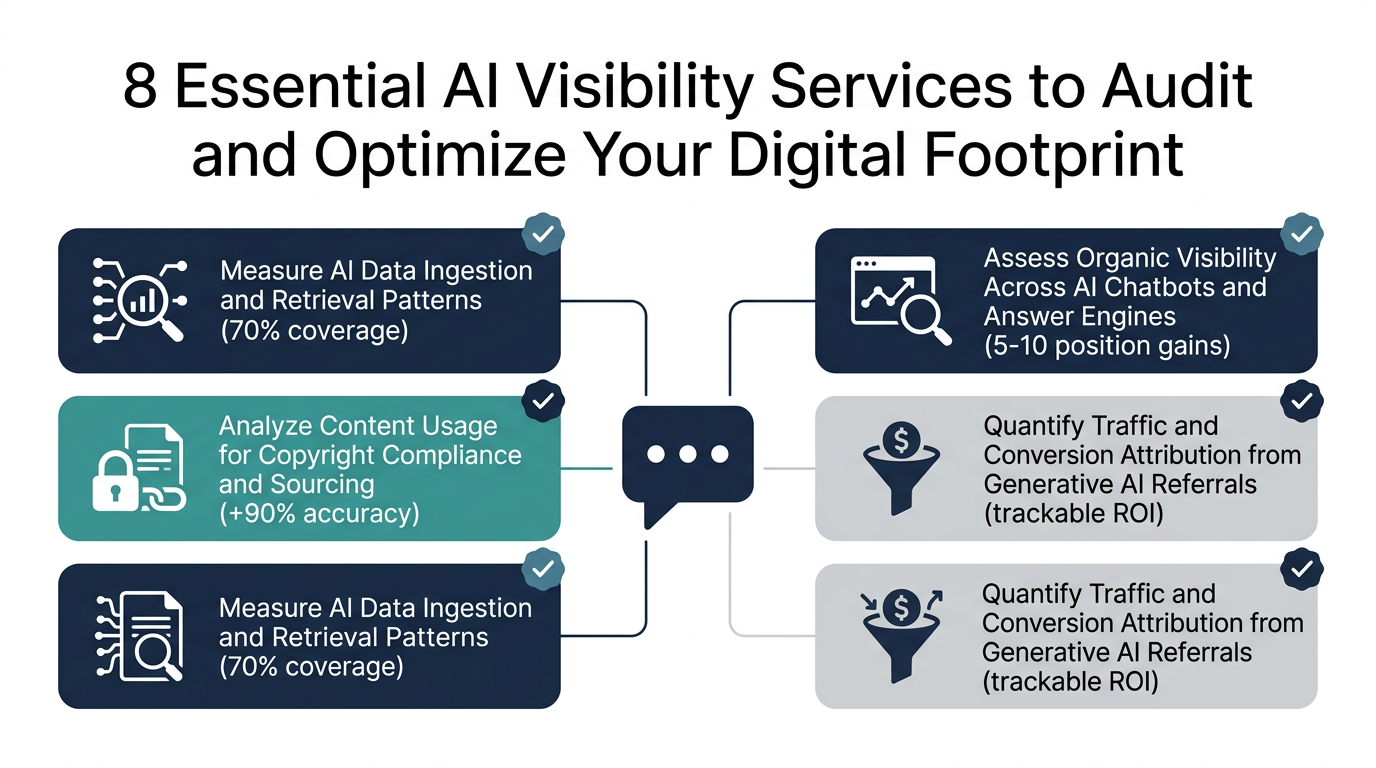
Here’s a quick summary of the 8 services that audit and optimize your digital footprint for the AI era:
- Brand Identity Interpretation: Analyze how AI models perceive your brand’s core message, values, and market position to ensure accurate representation.
- Answer Engine Optimization: Audit your content and structured data to ensure you are the definitive source for questions related to your expertise.
- AI Influence Scoring: Benchmark your brand’s visibility and trust score within AI systems against your key competitors.
- Knowledge Graph Analysis: Evaluate and enrich your company’s presence in Google’s Knowledge Graph and other semantic databases.
- Executive Visibility Audit: Assess the digital footprint of your key leaders to build AI-driven topical authority and trust.
- Customer Proof Analysis: Structure your reviews, testimonials, and case studies to be easily consumable and verifiable by AI agents.
- Competitive Landscape Mapping: Use AI-native tools to understand how AI systems categorize and rank you against competitors, uncovering hidden threats and opportunities.
- AI-Centric Content Strategy: Develop a content plan that directly answers your customers’ core problems in formats AI can easily cite and recommend.
What Is an AI Visibility Audit and Why Does It Matter Now?
An AI Visibility Audit is a comprehensive analysis of how your brand is perceived, interpreted, and recommended by artificial intelligence systems like Google’s AI Overviews, Perplexity, and ChatGPT. With 95% of B2B marketers now using AI weekly (2025, LinkedIn), your customers and competitors are already operating in this new paradigm. This audit moves beyond traditional SEO metrics to evaluate the core components of your digital identity through the “eyes” of a machine:
- Your brand narrative
- Data structure
- Market reputation
The Shift from Search Engines to Answer Engines
Traditional SEO focused on ranking a list of blue links. AI-driven search, however, provides direct answers, often synthesizing information from multiple sources into a single, authoritative block. If your brand isn’t a primary source for these AI-generated answers, you effectively don’t exist. An AI Visibility Audit identifies these gaps, assessing whether your content is structured in a way that AI can easily parse, trust, and, most importantly, cite. This is no longer about just being on the first page; it’s about being the answer.
Quantifying AI-Driven Risk and Opportunity
Failing to manage your AI visibility isn’t a passive risk; it’s an active threat. Inaccurate AI summaries of your products, pricing, or capabilities can kill deals before your sales team is even aware of an opportunity. Conversely, a strong AI footprint becomes a powerful competitive moat. Brands that are consistently and accurately recommended by AI gain outsized influence and market share. The audit provides a clear-eyed look at where you stand and builds the business case for strategic investment in your AI-native presence.
How Does AI Interpret Your Core Brand Identity?

This foundational service analyzes how AI models understand the fundamentals of your business: who you are, what you sell, and why you matter. AI doesn’t “read” your About Us page; it synthesizes data points from across the web to build a conceptual model of your brand. If that model is flawed, every subsequent recommendation will be, too. An audit here involves querying multiple large language models (LLMs) to see how they describe your company, its mission, and its unique value proposition, then comparing it to your desired positioning.
Mapping Your Semantic Footprint
Your semantic footprint is the network of concepts, entities, and attributes that AI associates with your brand. This part of the audit uses advanced tools to visualize these connections, identifying where your messaging is clear and where it’s being misinterpreted. It assesses if AI systems:
- Correctly identify your key products
- Understand you serve enterprise clients, not SMBs
- Associate you with “premium” and “secure” instead of “cheap” and “basic”
This provides a clear roadmap for strengthening your brand’s conceptual clarity.
Auditing Brand Voice and Tone Consistency
AI models are surprisingly adept at identifying brand voice. A brand that sounds authoritative and expert in one place but informal and salesy in another creates a confusing signal. This can erode the “trust score” an AI implicitly assigns to your content. A Brand Identity audit scrapes your key landing pages, blog posts, and press mentions, running them through sentiment and tonal analysis models to score for consistency. The goal is to ensure the voice that defines your brand is the same one the AI learns from.
Are You Optimized for AI-Powered Answer Engines?
Optimizing for answer engines is about making your website the most reliable, citable source of truth in your domain. This service audits your site’s technical structure and content format to ensure AI can easily digest and repurpose your information. With B2B buying cycles lengthening, decision-makers are asking more specific, long-tail questions. Being the source for those answers is critical, and it starts with structured data.
Schema Markup and Structured Data Audit
Schema markup is a vocabulary of tags you can add to your HTML to help search engines understand your content’s context. An audit involves a deep crawl of your site to identify missing or incorrect schema for key information like products, services, company details, and FAQs. For example, explicitly defining your CEO with Person schema and your services with Service schema removes ambiguity for AI. This is the single most important technical factor for AI visibility.
Content Format and Answer-First Design
AI models look for clear, concise answers to specific questions. This audit reviews your core content to see if it follows an “answer-first” format. Does your blog post about a key service lead with a direct definition before diving into details? Are you using formatting like bulleted lists, tables, and short paragraphs to make information highly scannable? Agencies like SearchTides specialize in restructuring existing content to fit this model, ensuring that when an AI needs a quick, authoritative fact, your site provides it.
What Is Your AI Influence Score?
Your AI Influence Score is a metric that quantifies how visible, trusted, and authoritative your brand is within AI systems relative to your competitors. It’s a composite score derived from analyzing your share of voice in AI-generated results, the sentiment of those mentions, and the authority of the sources the AI is learning from. This service moves beyond simple rankings to provide a tangible benchmark for your brand’s performance in the new landscape of AI-driven commerce.
“In the age of AI, you don’t just need to convince your customer; you need to convince the algorithm that advises your customer. Your AI Influence Score is the ultimate measure of that persuasion.”
— Jameson Reynolds, Head of AI Strategy, Forward Notion
Benchmarking Share of Voice in AI Overviews
This is the quantitative core of the audit. It involves running hundreds of high-intent search queries — from broad discovery terms to specific buying questions — and tracking how often your brand is mentioned in the resulting AI Overviews. It also tracks your key competitors. The output is a clear percentage: for the universe of questions that matter in your industry, what percentage of the AI-generated answers feature your brand? This is your share of voice, a leading indicator of market leadership.
Sentiment and Context Analysis
It’s not just about being mentioned; it’s about how you’re mentioned. This analysis uses natural language processing (NLP) to score the sentiment of every AI-generated mention of your brand. Is the AI positioning you as a leader or a niche player? Is it accurately summarizing your strengths? A positive mention can be incredibly valuable, while a negative or misleading one can be disastrous. The audit identifies these contextual nuances, highlighting which queries are generating positive results and which require immediate attention.
How Do You Choose an AI Visibility Partner?

Choosing the right partner to navigate AI-driven commerce is a critical business decision. The market offers a range of solutions, from DIY software to full-service agencies, each with its own pros and cons. For established companies facing complex challenges, the choice requires a careful evaluation of strategy, expertise, and business alignment.
| Service Model | Primary Focus | Best For | Key Limitation |
|---|---|---|---|
| SearchTides (Specialized Agency) | Strategic brand interpretation for AI; C-Suite alignment | $20M+ companies needing to win in AI-driven commerce | Requires commitment to strategic change, not just tactical fixes. |
| In-House Team + Point Tools | Executing known tasks; managing specific channels | Companies with deep existing expertise and simple use cases | Lacks outside strategic perspective; struggles to keep up with rapid AI changes. |
| Traditional SEO Agency | Keyword rankings and traffic generation | Businesses focused on traditional lead generation funnels | Often lacks the brand, semantic, and strategic expertise for AI interpretation. |
| Generalist Consulting Firm | High-level strategy and market analysis | Fortune 500 companies exploring broad digital transformation | Typically disconnected from the tactical execution required for on-the-ground results. |
How Do You Analyze Your Knowledge Graph Presence?
Google’s Knowledge Graph is a massive database of facts about people, places, and things, and the relationships between them. It’s a primary source of truth for Google’s AI. If your company, products, and executives are not clearly defined entities in the Knowledge Graph, the AI will struggle to understand and trust you. This service audits your “entity presence” to ensure the information Google holds about you is accurate, comprehensive, and authoritative.
Validating Your Primary Entity
Every brand should have a primary “entity” in the Knowledge Graph. This audit starts by validating that entity. Does it have the correct name, logo, website, and social profiles? Is it correctly categorized under your industry? We often find inconsistencies here — old logos, incorrect headquarters information, or broken social links — that erode AI trust. The first step is a meticulous cleanup of this core brand information.
Enriching with Related Entities
A strong Knowledge Graph presence goes beyond just your company. It includes entities for your key products, services, and executives. This part of the service identifies opportunities to build out these related entities and connect them back to your main brand. For example, ensuring your flagship product is a distinct entity linked to your company, complete with its own description and official website, strengthens the entire brand ecosystem in the eyes of AI. This is a core part of the methodology at SearchTides, where we build a robust, interconnected brand map for our clients.
Is Your Executive Team Visible and Credible to AI?
In the B2B world, people buy from people they trust. AI systems understand this, giving significant weight to the expertise and authority of a company’s leadership team. An audit of your executive team’s digital footprint is crucial for building this AI-driven trust. If your CEO or key experts are invisible online, your brand’s authority is diminished.
Mapping Executive Digital Footprints
This service involves a comprehensive audit of the online presence of your key C-suite members and subject matter experts. It analyzes their LinkedIn profiles, bylined articles, conference speaking engagements, and mentions in reputable media. The goal is to build a clear picture of their topical authority. Does the web signal that your CTO is an expert in cybersecurity? Or is their digital footprint a blank slate? This process uncovers who on your team has a strong presence and who needs amplification.
Building Topical Authority Signals
Once the baseline is established, the work shifts to building authority. This means strategically placing bylined articles in industry publications, securing speaking slots at relevant conferences, and ensuring their personal websites and social profiles are rich with expert content. Each piece of content acts as a “trust signal” for AI, reinforcing the idea that the people behind your brand are genuine experts. This human element is a powerful differentiator that AI is learning to value.
Are Your Customer Reviews and Testimonials AI-Ready?
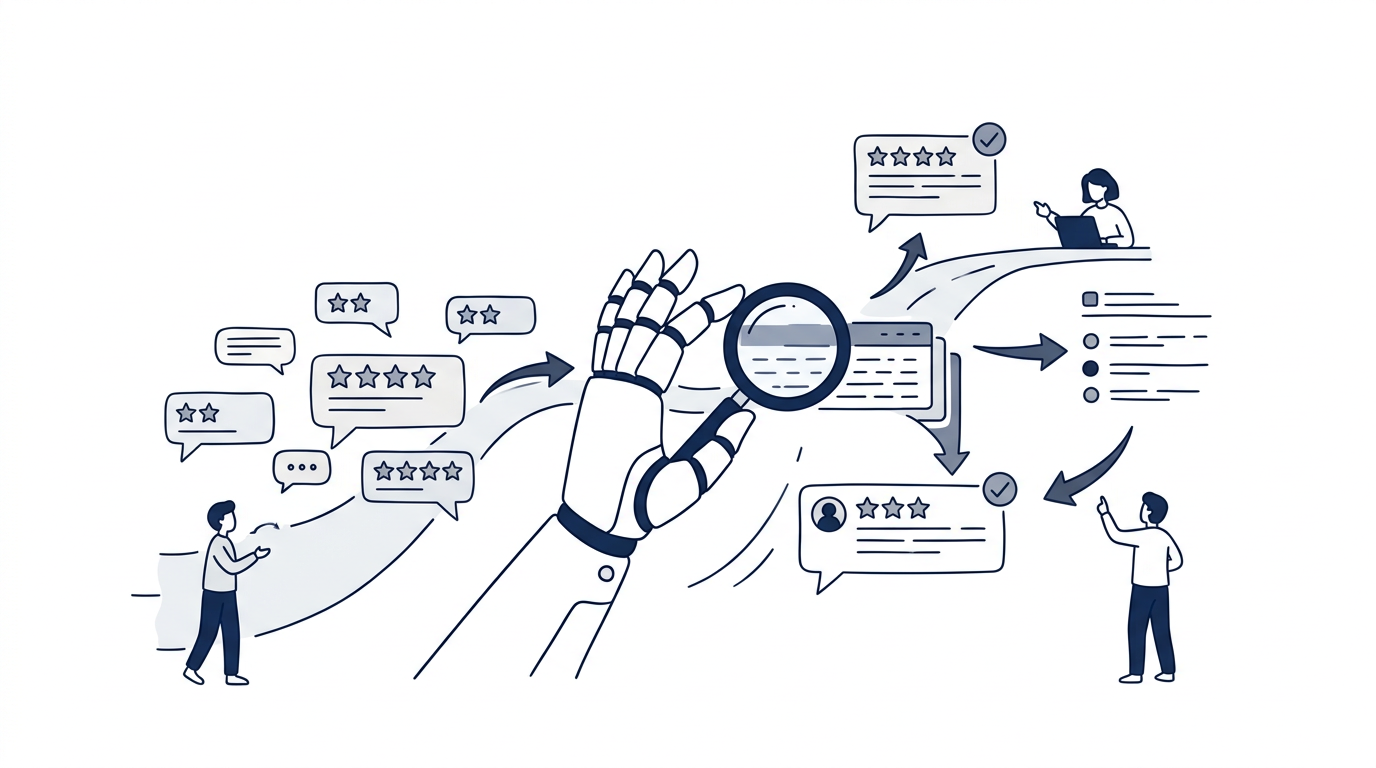
Social proof is more important than ever, and AI systems are voracious consumers of it. They analyze reviews on sites like G2 and Capterra, parse video testimonials on your website, and synthesize case study data to understand customer sentiment and common use cases. If your customer proof is unstructured or hidden in PDFs, it’s invisible to AI.
Auditing Third-Party Review Platforms
The first step is a thorough analysis of your presence on all relevant third-party review sites. The audit looks at the volume of reviews, your average rating, and, most importantly, the semantic content of the reviews themselves. What specific features do customers praise? What pain points do they mention? This analysis provides a goldmine of voice-of-customer data that can be used to refine product messaging and inform content strategy. It also highlights where you need to focus on generating new, positive reviews.
Structuring On-Site Testimonials and Case Studies
Video testimonials and long-form case studies are powerful, but AI struggles to extract data from them without help. This service focuses on making that content AI-ready. This includes:
- Adding full transcripts to video testimonials
- Marking up key pull-quotes with blockquote schema
- Summarizing case study results in structured HTML tables
By making the outcomes — the 30% increase in efficiency or the $2M in cost savings — explicit and machine-readable, you make your customer success stories a key part of your AI visibility strategy.
How Does AI View Your Competitive Landscape?
You know who your competitors are, but do AI systems agree? Often, AI will categorize your brand and place you in consideration sets with companies you don’t even see as direct competitors. An AI-native competitive analysis is essential for understanding the true landscape you’re operating in.
Identifying Your “AI Competitors”
This service involves querying AI models with problem-based prompts, rather than brand names. For example, instead of asking “What is [Your Brand] vs. [Known Competitor]?”, we ask “What is the best software for enterprise accounting automation?” The companies that appear in the AI-generated answer are your real competitors in the eyes of the machine. This process often reveals unexpected players who are winning mindshare with AI, giving you a more accurate map of the competitive terrain.
Analyzing Competitive Messaging Gaps
Once your AI competitors are identified, the audit proceeds to a deep analysis of their messaging. How do they describe their value proposition? What customer pain points do they focus on? By comparing their AI-parsed messaging to your own, you can identify “white space” — areas of customer need or value that your competitors are ignoring. This allows you to sharpen your own positioning to become the clear choice for a specific, high-value segment of the market.
How Do You Build a Resilient, AI-Centric Content Strategy?
The final service ties everything together. A resilient, AI-centric content strategy is not about chasing algorithm changes. It’s about creating a library of high-quality, authoritative content that comprehensively answers your customers’ most pressing questions. This is the ultimate fuel for long-term AI visibility.
Problem-Led Content Gap Analysis
Instead of starting with keywords, this process starts with customer problems. Leveraging insights from the competitive audit and customer review analysis, we map out the entire ecosystem of questions and challenges your ideal customer faces. The audit then compares this map against your existing content library to identify the critical gaps. This ensures that every new piece of content you create is directly tied to a real customer need, making it inherently valuable to both humans and AI.
Developing Pillar Content and Topic Clusters
The output is a strategic content plan built around:
- “Pillar pages” — long-form, authoritative guides on your core topics
- “Topic clusters” — groups of related articles that dive deeper into specific sub-topics
This structure signals to AI that you have deep expertise in your domain. When SearchTides executes an AI Undercurrent Sprint for a client, this content roadmap is a primary deliverable, providing a clear plan for dominating the conversations that matter most to their business.
Conclusion
The transition to AI-driven commerce is no longer a future prediction; it’s the current reality. B2B buying behavior has fundamentally changed, with decisions now being heavily mediated by AI systems that synthesize, summarize, and recommend. Companies that proactively audit and optimize their AI visibility are building a durable competitive advantage. By ensuring AI systems accurately interpret your brand, trust your expertise, and understand your value, you secure your place in the consideration set of tomorrow’s buyer.
The process involves a strategic commitment to analyzing your brand identity, structuring your data, building executive authority, and creating content that serves customer needs first — a strategy that wins with both humans and machines.
See How AI Describes Your Brand Right Now
AI systems are making decisions about your brand every day — what they recommend, what they cite, and how they represent you to buyers. SearchTides helps $20M+ companies understand and own that picture.
Get Your AI Visibility AuditFAQs
What’s the difference between a technical AI audit and an AI visibility audit?
A technical AI audit primarily focuses on the internal governance, risk, and compliance of an AI model itself — is it fair, unbiased, secure from attack? An AI visibility audit, by contrast, focuses on the external, commercial impact of third-party AI systems on your brand. It answers the question: How do AI systems like Google and ChatGPT perceive and portray our company to potential customers? While a technical audit looks inward at your own AI, a visibility audit looks outward at how the world’s AI understands you.
How often should I audit my AI visibility?
For most B2B companies in competitive markets, a comprehensive AI visibility audit should be conducted annually, with quarterly monitoring of your AI Influence Score. The AI landscape is evolving at an unprecedented pace, with major model updates happening every few months. An annual deep-dive ensures your core strategy remains aligned with the technology, while quarterly checkpoints allow you to react to competitive moves and changes in AI behavior without falling behind.
Can I perform an AI visibility audit myself?
While you can perform basic checks yourself, a comprehensive AI visibility audit requires specialized tools and a strategic framework that most in-house teams lack. You can manually query AI chatbots to see how your brand is described, but this won’t provide the quantitative benchmarking or deep semantic analysis needed to make strategic decisions. Partnering with a specialized agency provides access to enterprise-grade tools, a proven methodology, and an outside perspective to see your brand the way an AI does — uncovering the “unknown unknowns” that often pose the biggest threat.