

5 Critical Steps for Building an AI Brand Presence in a Post-Google World
94% of B2B buyers now use AI in their purchasing process. If AI agents don’t understand your brand, they can’t recommend it.

Your B2B buyers are already using AI to make purchasing decisions, whether your brand is ready or not. A staggering 94% of business buyers report using AI in their buying process, according to Forrester’s 2025 data. Yet while 64% of B2B leaders see AI’s massive impact on sales, a mere 20% feel prepared for the shift.
Key Takeaways
- AI is the new buyer: 94% of B2B buyers now use AI in their purchasing process, making it a critical channel for brand presence. (Forrester, 2025)
- Mind the gap: Define your brand’s core identity for AI before attempting to scale promotion, ensuring AI systems interpret your value correctly.
- Structure is strategy: Use structured data and semantic HTML to create a machine-readable “digital twin” of your brand for AI to consume.
- Visibility over traffic: The goal is not just clicks but being the authoritative answer AI models choose to cite and recommend to users.
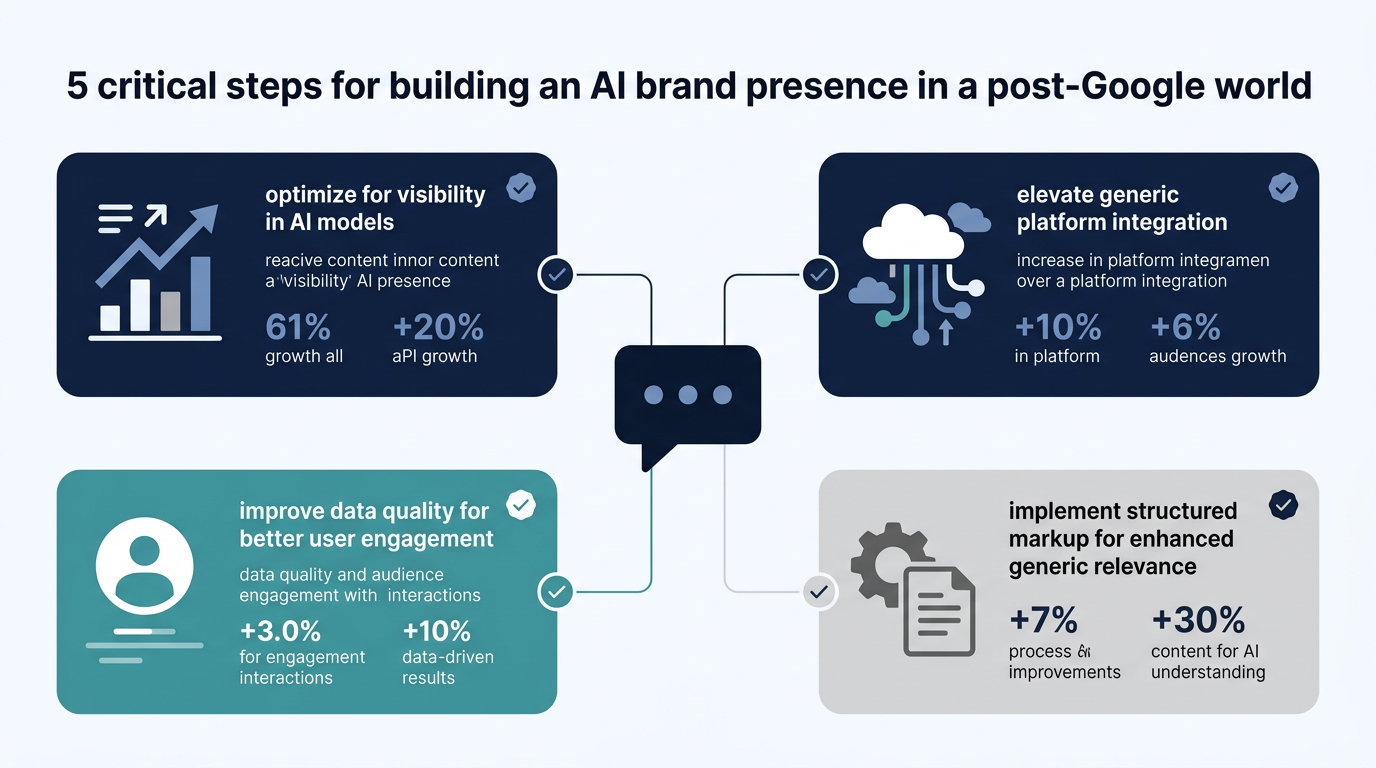
Here’s a quick summary of the 5-step framework for leaders to ensure their brand is understood, trusted, and chosen in an era of AI-driven commerce:
- Step 1: Define What AI Should Believe About Your Brand — Establish a single source of truth about your brand’s identity, value, and audience before an AI does it for you.
- Step 2: Create a Machine-Readable Digital Twin — Translate your brand identity into structured data and semantic content that AI crawlers can easily parse and understand.
- Step 3: Build Authority with High-Signal Content — Develop and distribute expert-driven content that answers specific user questions, making you an authoritative source for AI recommendations.
- Step 4: Optimize for Recommendation, Not Just Ranking — Focus on being the chosen answer in generative AI outputs by aligning content with the user intent behind long-tail queries.
- Step 5: Measure Your AI Influence Score — Implement a system to track how accurately and frequently AI systems represent and recommend your brand to your target buyers.
Step 1: Define What AI Should Believe About Your Brand
The first step in building an AI brand presence is to control your own narrative before AI models invent one for you. AI systems construct a “truth” about your brand by synthesizing every piece of data they can find: your website, third-party reviews, news articles, and structured data. Without a clear, consistent, and authoritative definition from you, the AI is likely to get it wrong, misrepresenting your company to potential buyers.
“A stunning 80% of deals are won by the “pre-contact favorite,” according to 6sense research, a favorite increasingly shaped by AI-driven research.”
— 6sense Research
Establish Your Core Brand Ontology
Your brand ontology is the foundational blueprint of who you are, what you do, for whom you do it, and why you’re the best choice. It’s more than a mission statement; it’s a structured vocabulary an AI can understand. This involves explicitly defining your company’s key attributes, services, target audience, and unique value propositions in a consistent and machine-readable format. Think of it as creating a “fact sheet” for a robot. This is the bedrock of your entire AI presence strategy. Without this clarity, all subsequent efforts are built on sand.
Conduct an AI Undercurrent Audit
Before you can tell AI what to think, you need to know what it currently believes. This requires an audit of your brand’s existing footprint across AI systems. How does ChatGPT, Gemini, or Perplexity describe your company? Do they mention your key services? Do they recommend you for the right problems? Agencies like SearchTides conduct an “AI Undercurrent Sprint” to perform this exact diagnosis, identifying the gaps between your desired brand perception and the AI’s current interpretation. This provides a clear, data-driven starting point for your strategy.
Create a Single Source of Truth
Based on your audit, consolidate your core brand ontology into a “single source of truth.” This can be a dedicated page on your website, a comprehensive JSON-LD schema, or a detailed About Us page written for both humans and machines. This page should explicitly state your ideal customer profile (ICP), the problems you solve, your key differentiators, and the outcomes you deliver. This document becomes the canonical reference point that AI systems will eventually learn to trust as the definitive source of information about your brand.
Step 2: Create a Machine-Readable Digital Twin

Once you’ve defined your brand’s truth, you must translate it into a language machines can parse and prioritize. A “digital twin” of your brand is a complete, structured, and semantically rich representation of your company online. Research shows B2B buyers now make decisions before ever talking to sales, and 95% of the time, the winning vendor is on the “Day One shortlist” (6sense, 2025) — a list increasingly compiled by AI.
Implement Comprehensive Schema Markup
Schema markup (using formats like JSON-LD) is the vocabulary of AI. It allows you to explicitly tell search engines and AI models what your content is about. Go beyond basic Organization and Article schema. Use Service, Product, FAQPage, AboutPage, and even Person schema to label every component of your business. This removes ambiguity and allows AI to understand your offerings with precision. For example, instead of letting an AI guess what a service does, you can define its serviceType, provider, and audience in the code.
Structure Your Website for Semantic Clarity
AI models don’t just read text; they analyze the structure of your HTML. To create semantic clarity:
- Use a logical hierarchy of headings (H1, H2, H3).
- Incorporate bulleted and numbered lists, and tables to organize information.
- Ensure each page has a single, clear purpose, announced by its H1 tag.
- Connect related concepts through internal linking, creating “topic clusters” that signal expertise to crawlers.
“Marketers need to shift from driving traffic to driving visibility. Buyers will spend more and more of their buying process with AI answer engines and less time engaging directly with vendors.”
— Amy Bills, VP, Principal Analyst, Forrester
Prioritize Clean Data and Fast Performance
Your digital twin must be reliable. This means:
- Ensuring your website is fast, secure (HTTPS), and free of broken links or crawl errors.
- Your sitemap should be a perfect mirror of your site architecture.
- Your
robots.txtfile must explicitly allow AI crawlers likeGoogle-ExtendedandChatGPT-User. - Verifying that your core brand information is easily accessible and not hidden behind complex JavaScript or user logins.
AI models prioritize trustworthy sources, and technical sloppiness is a red flag. Don’t assume they have access.
Step 3: Build Authority with High-Signal Content

To build a strong AI brand presence, you need to be seen as an authority, and authority is built on content that provides clear, expert answers. AI models are designed to find and synthesize the most definitive information to satisfy a user’s query.
“Forrester’s 2025 survey revealed that buyers name generative AI as a more meaningful source of information than any other source, including vendor websites.”
— Forrester 2025 Survey
Your goal is to become the source the AI turns to. This means shifting from content designed to attract clicks to content designed to be cited.
Focus on Answer-Driven Content
To create “high-signal” answer-driven content:
- Focus on very specific questions your ICP would ask (e.g., “What is the average integration time for X software?” rather than “Benefits of X Software”).
- Use the H2/H3 structure to ask and answer these questions directly.
- Utilize lists, tables, and bolded text to highlight key data points.
This makes your content easy for an AI to parse and excerpt for a generated answer. Every piece of content should be a potential citation.
Develop a Pillar-and-Cluster Model
Organize your expertise into a “pillar-and-cluster” model. The pillar page is a comprehensive guide on a core topic (e.g., “AI-Driven Commerce Strategy”). The cluster pages are shorter articles that dive deep into specific sub-topics linked from the pillar. This architecture demonstrates a deep, well-organized body of knowledge, signaling to AI models that you are a subject matter expert worthy of being a primary source.
Incorporate Unique Data and Expert Voices
Generic content is invisible to AI. To stand out, you need to publish unique insights. This can be from proprietary research, internal company data, or expert commentary from your leadership team. Include quotes, statistics, and data tables that are unique to your brand. When an AI model is looking for a specific data point to support an answer, it will prioritize the original source. Attributed quotes from named experts in your company also add a layer of E-E-A-T (Experience, Expertise, Authoritativeness, and Trustworthiness) that AI models are trained to value.
Step 4: Optimize for Recommendation, Not Just Ranking

In a post-Google world, the goal shifts from ranking #1 to being the chosen recommendation within an AI’s answer. A ranking is a link in a list; a recommendation is a direct endorsement woven into a conversational response. Since 83% of B2B buyers prefer digital-first purchasing channels, getting that AI endorsement is paramount.
Target Conversational and Long-Tail Keywords
The queries people use with conversational AI are different. They are longer, more natural, and often framed as questions. Your content strategy must target these long-tail keywords. Instead of optimizing for “B2B CRM,” optimize for “what is the best B2B CRM for a mid-market manufacturing company with complex sales cycles?” Use tools that analyze conversational queries to build your content briefs. Answering these specific, high-intent questions positions you as the expert that AI should cite.
Analyze and Emulate Cited Content
Actively research which sources AI models are already citing for your target topics. Ask ChatGPT, Perplexity, and other models questions your buyers would ask. When they provide a source, analyze that content. What is its structure? What format is the answer in (list, paragraph, table)? How do they use data? Reverse-engineer the content that is already winning, and create a better, more comprehensive, and more authoritative version.
Create Comparison Frameworks and Tables
B2B buyers use AI to compare options. Pre-empt this by creating the comparison content yourself. Tables are particularly effective as they are highly structured and easy for AI to parse. Compare features, pricing, and use cases against competitors or different methodologies. By providing the framework for comparison, you control the narrative and the criteria for evaluation.
| Evaluation Criteria | Traditional SEO Agency | Generic Digital Agency | SearchTides (AI-Native) |
|---|---|---|---|
| Primary Goal | Drive traffic via rankings | Brand awareness, leads | Drive revenue via AI recommendation |
| Core Deliverable | Keyword reports, link building | Creative campaigns, media buys | AI Influence Scorecard, Brand Ontology |
| Key Metric | SERP Position | Impressions, MQLs | Share of AI Voice, Recommendation Rate |
| Ideal For | Commodity products in stable markets | Large consumer brands | $20M+ companies in complex B2B markets |
Step 5: Measure Your AI Influence Score
In AI-driven commerce, traditional marketing KPIs like traffic and keyword rankings are insufficient. They measure activity, not influence. You need a new set of metrics that track how AI systems perceive and promote your brand. This “AI Influence Score” is a composite metric that quantifies your brand’s visibility, accuracy, and sentiment within the generative AI ecosystem. Without measurement, you are flying blind, unable to prove ROI or strategically improve your position.
Track Your “Share of AI Voice”
Your “Share of AI Voice” is the percentage of times your brand is mentioned by AI models in response to a core set of unbranded, high-intent queries, compared to your competitors. For example, for a set of 100 queries relevant to your industry, how many times was your brand recommended? This is the new “share of search.” The AI Influence Scorecard from SearchTides automates this tracking to provide a clear competitive benchmark.
Monitor Brand Accuracy and Sentiment
It’s not enough to be mentioned; the mention must be accurate and positive. Regularly audit how AI models describe your company:
- Are they using the correct value propositions from your brand ontology?
- Are they associating you with the right customer problems?
- Use a simple scoring system: +1 for a positive, accurate mention, 0 for a neutral or absent mention, and −1 for a negative or inaccurate one.
Track this score over time to measure the impact of your content and structured data efforts.
“In an AI-first world, your brand is not what you say it is. It’s what the AI says it is. The brands that win will be those that actively shape that narrative, treating the AI as their most important new customer.”
— James Parsons, CEO, SearchTides
Correlate AI Presence with Business Outcomes
The ultimate goal is to connect your AI Influence Score to revenue. Track your AI Share of Voice against inbound lead quality, sales cycle length, and win rates for un-assisted deals. As your brand becomes the default recommendation by AI, you should see a corresponding lift in high-quality, bottom-of-funnel prospects who arrive pre-sold on your solution.
Conclusion
The transition to an AI-driven commercial landscape is no longer a future prediction; it is the current reality. With 94% of B2B buyers already using AI, companies that fail to build a deliberate brand presence within these new systems risk becoming invisible. The winners will not be those who simply continue with traditional SEO, but those who strategically define their brand for machines, build authority through high-signal content, and optimize for recommendation.
By following these five critical steps — defining your brand’s truth, building a digital twin, creating authoritative content, optimizing for recommendation, and measuring your AI influence — you can move from being unprepared to being the dominant voice in your category. The time to act is now.
See How Your Brand Scores in the New AI Landscape
SearchTides helps $20M+ companies build a deliberate, measurable presence within the AI systems that now guide B2B buying decisions.
Get Your AI Influence ScorecardFAQs
What is the difference between AIO and SEO?
AIO (Answer Engine Optimization) focuses on getting your brand recommended within AI-generated answers, while SEO focuses on ranking your website in a list of links. SEO is about traffic and visibility in a list, using keyword optimization and backlinking. AIO is about influence and authority, ensuring AI models understand your brand’s expertise so well they choose to cite you. The KPIs are different too: SEO measures rankings and clicks, while AIO measures your “Share of AI Voice” and the accuracy of your brand’s representation in AI outputs.
How long does it take to build an AI brand presence?
Building a foundational AI brand presence can take 3 to 6 months of focused effort, with ongoing optimization after that. The initial phase involves deep work: defining your brand ontology, auditing your current AI footprint, implementing comprehensive structured data, and publishing an initial set of high-signal content. Firms like SearchTides often package this initial strategic work into a 90-day “AI Undercurrent Sprint.” While you can see improvements in how AI interprets your brand within this timeframe, achieving a dominant “Share of AI Voice” is a long-term commitment.
Do I need a special tool to optimize for AI search?
While you can start with foundational tools you already use, specialized tools are becoming essential for effective AI optimization. The most critical gap is measurement. Standard analytics tools don’t track how your brand is represented in AI chats or measure your “Share of AI Voice” against competitors. To do this effectively, you need platforms or agency services that can programmatically query AI models at scale and analyze the results. For content creation, AI can help, but the strategy still requires human expertise to define the brand ontology and create unique, authoritative insights that stand out.